

EV Tax Credits Ending Soon: Now Is the Best Time to Go Electric
Why Go Electric Now?
All-electric, plug-in hybrid, and fuel cell electric vehicles purchased new in 2023 or after can still be eligible for a federal income tax credit of up to $7,500. The availability of the credit will depend on several factors, including the vehicle’s MSRP, its final assembly location, battery component and/or critical minerals sourcing, and your modified adjusted gross income (AGI)
If you are considering buying a new or used EV, be aware that federal incentives are ending soon: the $7,500 incentive for eligible new EVs and the $4,000 incentive for used EVs will disappear after September 30. Currently, you can either choose to claim the credit on your federal taxes or opt to transfer the credit to an eligible dealer for an immediate discount on the vehicle at purchase.The $7,500 to leasing companies (which lets them significantly reduce lease cost) will also end on September 30.
To qualify for the EV purchase incentives, your income must fall beneath a certain threshold and the vehicle must meet IRS specifications. EVs currently eligible for $7,500 incentive are:
- Acura ZDX
- Cadillac Lyriiq, Optiq, Vistiq
- Chevy Blazer, Equinox, Silverado
- Chrysler Pacifica PHEV
- Ford F-150 Lightning (FLASH, LARIAT, XLT trims)
- Genesis GV70
- GMC Sierra EV
- Honda Prologue
- Hyundai Ioniq 5, Ioniq 9
- Jeep Wagoneer S
- Kia EV6, EV9
- Tesla Cybertruck, Model 3, Model Y
Plug In America will held a webinar on the federal EV incentive changes on Wednesday, July 16. You can find the recording and other useful information here.
Qualified vehicles purchased before 2023 may be eligible for a similar tax credit of up to $7,500.
Pre-owned vehicles purchased in 2023 or after are eligible for a tax credit of up to $4,000.
- Visit the Plugin America site to find out more about tax credits based on your income, eligible vehicles, and tax credits for used vehicles.
- Stay connected with Valley Clean Energy’s EV page to get more details on upcoming EV programs.
One more resource for finding EV incentives is ElectricForAll.org’s incentive finder, where you can find all the federal, state, local, and utility incentives available by ZIP code. Discover everything you need to know about driving an electric vehicle at ElectricForAll.org. Shop and compare electric vehicles, find vehicle and charging incentives specific to your ZIP code, and explore home charging options — all in one place. Learn how EVs can save you money and contribute to cleaner air for all. Start your journey to a cleaner, more affordable drive today!
EV Charging is Ubiquitous and Still Growing
Charging for electric vehicles is expanding everywhere, especially along the major travel corridors. While most EV owners charge their vehicles at home to cover their commuting, growth in charging along our major travel corridors makes both long distance trips and commuting even easier. It also appears the administration is NOT appealing a judge’s order for the National Electric Vehicle Infrastructure (NEVI) funds to start flowing again. This will enable the release of nearly $1 billion for public charging along major highways in 14 states. Don’t forget, tools like PlugShare make it easy for owners to plan for charging during a long distance journey.
Follow Us


FACEBOOK FEED

TWITTER FEED


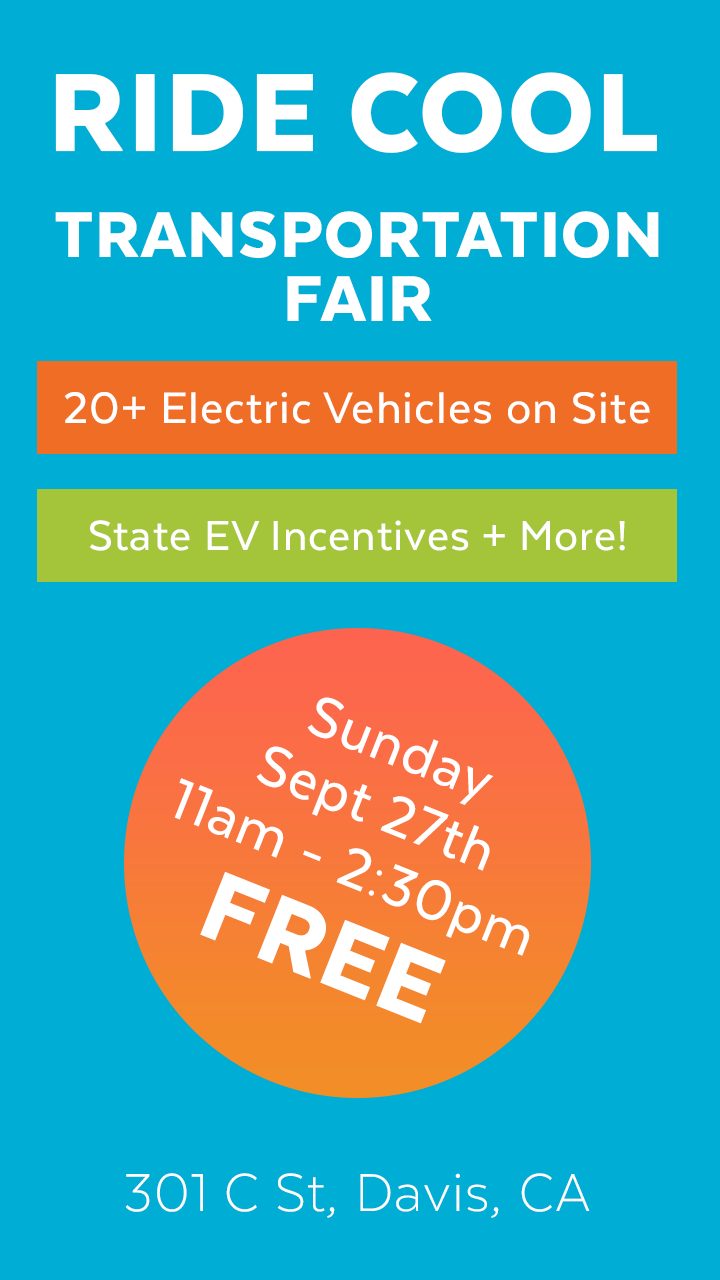
Curious about EVs? E-bikes? Want to learn about them without the sales pitch? Then come this Sunday to talk directly to owners and check out all the green transportation options in #Davis and #Yolo
Don't freak out, there's still time! Please give to help us meet our goal by midnight! #yoloca #bdog2024 #givebig2024 #nightowls https://www.bigdayofgiving.org/cooldavis

Thank you for helping us fly free with your evening donations (not easy in the dark ;) #yoloca #bdog2024 #givebig2024 https://www.bigdayofgiving.org/cooldavis

Yolo we are so close to our Big Day of Giving goal! Thank you for being on the move and helping us make a much needed $40,000 by midnight tonight! #yoloca #bdog2024 #givebig2024 @yolocommunityfdn https://www.bigdayofgiving.org/cooldavis

There's no masking your generosity! Reveal your true colors and support us today for Big Day of Giving! #yoloca! #bdog2024 #givebig2024 #mayisbikemonth https://www.bigdayofgiving.org/cooldavis

